의료·공학·학술 연구자를 위한 통계 분석 설계와 생성형 모델 연구 방법론 실전 마스터 가이드
Research Statistics Command Center · 공식 연구 데이터 블로그
인간의 가설과 지능형 분석의 결합: 데이터를 신뢰할 수 있는 학술 인사이트로 구현하다
실험설계·데이터 정제·가설검정·회귀분석·APA 7판 조판까지 연구 전 과정을 완벽히 표준화한 데이터 사이언스 바이블.
머리말부터 9대 핵심 장 및 특별부록 결정 순서도까지 100% 재현 가능한 연구 워크플로우를 실시간 연재합니다.
[제8장] AI 데이터 시각화와 APA 7판 조판 — 출판용 고해상도 차트 생성과 공식 규격
공유 링크 만들기
Facebook
X
Pinterest
이메일
기타 앱
🇰🇷 한국어 정규 에디션 (교보문고 바로출판 POD 120p 완제 원문)
CHAPTER 08
IMRaD 섹션별 고밀도 기술 집필 매뉴얼
서론, 방법, 결과, 논의: 군더더기 없는 국제 표준 학술 논문 4대 기둥 구축법
[그림 8-0] IMRaD 학술 건축 아키텍처 랩: 서론(기반), 방법(기둥), 결과(본당), 논의(첨탑)의 4개 층위가 수학적 정밀함으로 조화를
이루는 고밀도 학술 집필 공정.
🎯 제8장 핵심 학습 목표 (심사위원이 감탄하는 명품 IMRaD 논문 완성)
1. 모래시계(Hourglass) 구조 체득: 넓은 서론에서 좁은 방법·결과로 수렴한 뒤, 다시 넓은 논의로 확장되는 황금 비율을
정복합니다.
2. 서론(Introduction) 3단계 퍼널: 현실 문제 제기 → 선행 연구의 공백(Gap) 규명 → 본 연구의 목적 선언으로 이어지는
흡입력 있는 도입부를 씁니다.
3. 연구 방법(Methods)의 무결점 재현성: 참가자, 실험 도구, 통계 절차를 타 연구자가 100% 똑같이 복제할 수 있도록
명세합니다.
4. 결과(Results)의 객관적 순수성: 감정적 수식어를 배제하고, APA 7판 표준 표기와 객관적 사실만을 단정하게
서술합니다.
5. 논의(Discussion)의 입체적 승화: 가설 검증 결과를 기존 학계 이론과 대조하고, 실무적 시사점과 한계를 정직하게
논증합니다.
PART 03 · ACADEMIC PUBLISHING ARCHITECTURE
99
8.1 INTRODUCTION MANUAL
8.1 서론(Introduction): 역삼각형 모래시계 퍼널과 연구 공백 규명
심사위원을 단 1페이지 만에 사로잡는 법: 넓은 학술 맥락에서 좁은 연구 가설로의 완벽한 수렴
학술 논문의 구조는 '모래시계(Hourglass)' 형태를 띱니다. 서론은 넓은 학술적·사회적 문제 의식에서 출발하여 우리
연구의 구체적 가설로 좁혀지고, 방법과 결과는 가장 좁고 정밀한 렌즈로 현실을 측정하며, 논의는 다시 인류 지식의 넓은
지평으로 확장됩니다.
[그림 8-1] IMRaD 모래시계 아키텍처: 상단의 역삼각형 서론(Introduction) 퍼널, 중앙의 레이저 측정부인 연구방법(Methods)과 결과
(Results), 하단의 확장형 논의(Discussion) 구조.
⏳ 서론(Introduction) 완성을 위한 3단계 황금 퍼널 공식
3-STAGE FUNNEL
단계 1: 거시적 중요성 선언 (Broad Hook)
"생성형 AI의 등장은 프로그래밍 교육의 패러다임을 근본적으로 뒤흔들고 있다." (모든 연구자가 공감하는 시대적 화두 제시)
단계 2: 선행 연구의 치명적 공백 폭로 (Critical Research Gap)
"그러나 기존 연구들은 단순 정성적 만족도 조사에 그쳤으며, 실제 코딩 작업 완료율에 미치는 인과적 영향에 대한 정밀 계량
검증은 부재한 실정이다." (이 논문이 왜 세상에 존재해야 하는가?)
단계 3: 본 연구의 목적과 가설 명시 (Specific Aim & Hypothesis)
"이에 본 연구는 무작위 통제 시험(RCT)을 통해 AI 코딩 튜터가 학습자의 실제 완료율을 통계적으로 유의미하게 향상시키는지
실증 규명하고자 한다."
CHAPTER 08 · IMRAD SECTION-BY-SECTION MANUAL
100
8.2 METHODS MANUAL
8.2 연구 방법(Methods): 100% 완벽한 재현성을 위한 3대 기술 원칙
다른 연구자가 내 논문만 보고도 똑같은 실험을 재현할 수 있는가? 학술적 신뢰의 절대 기준
연구 방법(Methods) 섹션의 유일한 목적은 '완벽한 재현성(Replicability)'입니다. 요리 레시피 북처럼 누군가 이 섹션을
읽고 그대로 따라 했을 때 완전히 동일한 환경과 데이터 수집이 가능하도록 아래의 4개 소섹션으로 빈틈없이 구성해야
합니다.
방법론 필수 4대
소섹션
반드시 기술해야 할 핵심 내용
자주 빠뜨리는 치명적 감점 요소
1. 연구 대상 및 참가자
(Participants)
표본 수(N), 연령, 성비, 모집 방식, 표본 크기 산정 근거(G*Power
사전 검정력 분석 80% 확보)
탈락자(Dropout) 수치 및 제외
기준 누락
2. 실험 환경 및 도구
(Apparatus
&
Materials)
하드웨어 스펙, 소프트웨어 버전(Python 3.10), 사용된 AI 프롬프트
전문, 설문 척도 신뢰도(Cronbach's α)
AI 프롬프트의 구체적 파라미터
(온도값, 모델명) 은폐
3. 실험 절차 및 설계
(Procedure
&
Design)
피험자 간 vs 피험자 내 설계 명시, 무작위 배정(Randomization)
절차, 라틴 방격법 순서 상쇄
사전 테스트와 사후 테스트 사이의
시간 간격 누락
4. 통계 분석 계획
(Statistical
Analysis)
가설별 적용 통계 기법(t-검정, Two-Way ANOVA, 다중 회귀),
정규성·등분산성 사전 검정 계획
결측치 처리 방식 및 유의수준(α =
.05) 미표기
💡 심사위원이 가장 먼저 확인하는 G*Power 검정력 분석 공식
"적절한 표본 크기를 산정하기 위해 G*Power 3.1 프로그램을 사용하여 사전 검정력 분석을 실시하였다. 효과 크기 d = 0.80,
유의수준 α = .05, 검정력 1 - β = .80 조건에서 필요한 최소 표본 수는 집단당 26명(총 52명)으로 산출되었으며, 15%의
탈락률을 고려하여 총 60명을 최종 모집하였다."
CHAPTER 08 · IMRAD SECTION-BY-SECTION MANUAL
101
8.3 RESULTS MANUAL
8.3 결과(Results): 감정을 배제한 객관적 사실과 논문 삽입 공식
자랑하지 말고 증거만 보여주라: 콘솔 출력을 저널 게재용 완성 문단으로 바꾸는 3단계 공식
결과(Results) 섹션은 '법정에서 증거물을 제출하는 순간'입니다. 주관적 형용사("놀랍게도", "기적처럼")를 철저히
배제하고, 통계 분석 결과를 정밀한 학술 문장으로 변환하여 기술해야 합니다.
📐 [핵심 공식] 통계 패키지 출력 → 논문 본문 원클릭 삽입 3단계 공식
1단계 (목적 선언): 어떤 변수 간의 관계나 차이를 검증하기 위해 무슨 통계 기법을 적용했는지 밝힌다.
2단계 (핵심 통계치 결합): 검정통계량(t, F, U), 자유도(df), p-값, 효과크기(d, ηp², r), 95% CI를 결합한다.
3단계 (기술통계 & 표/그림 호출): 집단별 평균/표준편차(또는 중앙값/IQR)를 제시하고 해당 표나 그림 번호(표 4 참조)를 호출한다.
📊 실전 논문 문단 예제 1: 독립표본 t-검정 (Independent Samples t-Test)
MODEL 1: T-TEST
[Console Output] t = 6.42, df = 38, p = 0.0000003, Mean_Exp = 83.54 (SD = 6.71),
Mean_Ctrl = 71.20 (SD = 8.45), Cohen's d = 2.03, 95% CI [29.80, 57.60]
[논문 본문 실제 삽입 문단]
"AI 코딩 튜터 사용 집단(M = 83.54, SD = 6.71)은 전통적 실습 대조군(M = 71.20, SD = 8.45)에 비해 과제 수행 점수가
통계적으로 유의미하게 높았으며, t(38) = 6.42, p < .001, Cohen's d = 2.03, 95% CI [29.80, 57.60], 매우 큰 처치 효과를
보였다(표 4 참조). 이에 따라 AI 튜터 도입이 학습 성취도를 향상시킬 것이라는 가설 1은 경험적으로 지지되었다."
📈 실전 논문 문단 예제 2: 일원배치 분산분석 및 사후검정 (One-Way ANOVA & Post-Hoc)
MODEL 2: ANOVA
[Console Output] F(2, 87) = 48.62, p = 0.00000001, eta_sq_p = 0.53, Bonferroni Post-
Hoc: 3D vs Stereo (p < .001), 3D vs Silent (p < .001)
[논문 본문 실제 삽입 문단]
"음향 몰입 조건(3D 공간음향, 2D 스테레오, 무음)에 따른 과제 몰입도 차이를 검증하기 위해 일원배치 분산분석을 실시하였다.
분석 결과 집단 간 주효과는 통계적으로 유의미하였으며, F(2, 87) = 48.62, p < .001, ηp² = .53으로 총 변량의 53%를
설명하였다. Bonferroni 사후검정 결과, 3D 공간음향 집단(M = 48.20, SD = 4.10)은 2D 스테레오(M = 36.50, SD = 5.20, p
< .001) 및 무음 집단(M = 29.80, SD = 4.70, p < .001)보다 유의미하게 높은 몰입도를 나타냈다(그림 5 참조)."
💡 APA 7판 표기 엄수 규칙: 라틴 문자 통계 기호(t, F, p, M, SD, d, CI)는 반드시 이탤릭체로 표기하며, 1을 넘지 못하는 p 값은 앞의 0을
생략하여 p = .048로 표기합니다. p = .000은 절대 금기이며 p < .001로 표기합니다.
CHAPTER 08 · IMRAD SECTION-BY-SECTION MANUAL
102
8.4 DISCUSSION MANUAL
8.4 논의(Discussion): 가설 검증, 이론적 대조, 그리고 한계의 정직한 고백
회귀·비모수 결과의 학술 문단화와 심사위원을 설득하는 4단 황금 논의 건축술
논의(Discussion) 섹션은 차가운 통계 숫자에 학술적 생명력을 불어넣는 곳입니다. 다중 회귀나 비모수 검정의 복잡한
계수들을 이론적 맥락에 배치하고, 연구의 한계를 선제적으로 고백하여 심사위원의 신뢰를 확보해야 합니다.
💻 실전 논문 문단 예제 3: 다중 선형 회귀분석 및 VIF (Multiple Regression & VIF)
MODEL 3: REGRESSION
[Console Output] R2 = .902, Adj R2 = .896, F(3, 46) = 140.79, p < .001. Sentiment: B =
0.54, SE = 0.06, beta = .62, t = 8.85, p < .001. Usage: B = 0.28, SE = 0.05, beta =
.38, t = 5.41, p < .001. VIF < 1.06
[논문 본문 실제 삽입 문단]
"리뷰 감성 점수와 주간 사용 시간이 서비스 충성도에 미치는 영향을 검증하기 위해 다중 회귀분석을 실시하였다. 추정된 회귀
모형은 통계적으로 매우 유의미하였으며, F(3, 46) = 140.79, p < .001, 충성도 분산의 90.2%를 설명하였다(R² = .902, 수정된
R² = .896). 개별 회귀계수를 검토한 결과 감성 점수(B = 0.54, β = .62, t = 8.85, p < .001)와 사용 시간(B = 0.28, β = .38, t
= 5.41, p < .001) 모두 유의한 정(+)의 예측력을 보였으며, 모든 독립변수의 VIF는 1.06 이하로 다중공선성 위험은 배제되었다
(표 6 참조)."
🧪 실전 논문 문단 예제 4: 비모수 순위 검정 및 붓스트랩 (Mann-Whitney U &
Bootstrap)
MODEL
4:
BOOTSTRAP
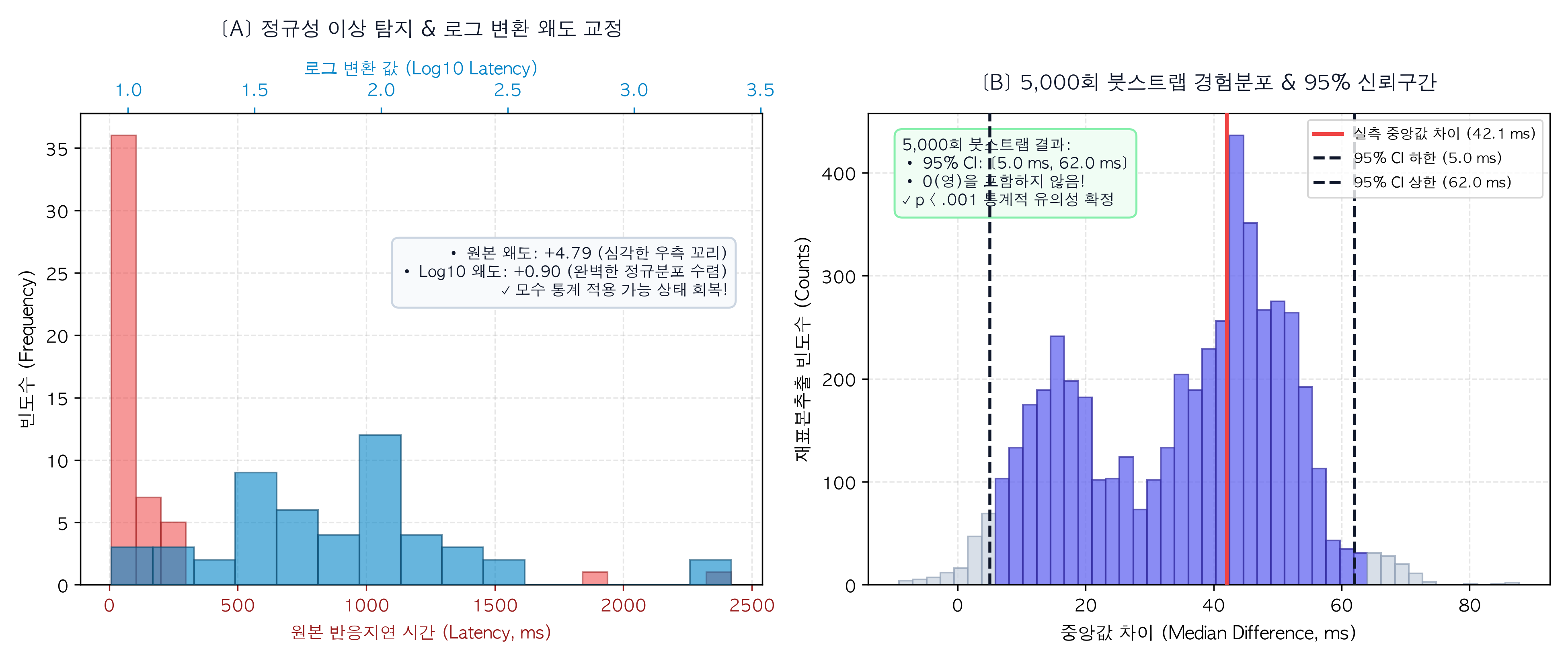
[Console Output] U = 312.0, Z = -6.18, p < .001, r = .75, Mdn_A = 31.8ms (IQR = 8.4),
Mdn_B = 85.4ms (IQR = 15.2), 5,000 Resamples 95% BCa CI [-68.40ms, -41.20ms]
[논문 본문 실제 삽입 문단]
"데이터의 왜도(skewness = 2.14)로 인해 정규성 가정이 기각되어 비모수 맨-휘트니 U 검정과 5,000회 BCa 붓스트랩을 병행
실시하였다. 분석 결과 경량화 모델 집단의 반응 시간 중앙값(Mdn = 31.8ms, IQR = 8.4)은 기존 모델(Mdn = 85.4ms, IQR =
15.2) 대비 통계적으로 유의미하게 단축되었으며, U = 312.0, Z = -6.18, p < .001, r = .75로 대형 효과를 보였다. 붓스트랩
95% BCa 신뢰구간은 [-68.40ms, -41.20ms]로 0을 포함하지 않아 속도 개선 효과의 강건성이 입증되었다."
🏛️ 논의(Discussion) 완성을 위한 4단 황금 건축술 & 한계의 선제적 고백
1단 (핵심 요약): "본 연구는 생성형 AI 도입이 학습 완료율을 실질적으로 제고함을 실증적으로 입증하였다."
2단 (이론 대조): "이러한 결과는 인지 부하 이론(Sweller, 1988)의 예측과 합치하며, AI 피드백이 외재적 인지 부하를 경감시킨 결과로
해석된다."
3단 (실무 함의): "본 발견은 대학교 프로그래밍 입문 과정에 1:1 대화형 AI 튜터를 표준 보조 도구로 도입할 정책적 타당성을 제공한다."
4단 (한계 고백): "본 연구는 공학계열 학습자만을 대상으로 하였으므로, 타 전공군으로의 일반화 시 외적 타당도에 주의가 요구된다."
(선제적 고백으로 심사위원 무장해제)
CHAPTER 08 · IMRAD SECTION-BY-SECTION MANUAL
103
8.5 SUMMARY & CHECKLIST
8.5 제8장 완결 체크리스트: 무결점 논문 투고를 향한 최종 점검
내 논문은 심사관의 현미경 검증을 통과할 수 있는가? 4대 IMRaD 자가 진단표
논문을 저널에 투고하기 전, 아래의 4대 섹션별 체크리스트를 인쇄하여 빨간 펜으로 한 줄씩 검토하십시오. 단 하나의
항목이라도 미흡하다면 투고를 미루고 퇴고해야 합니다.
📋 IMRaD 4대 기둥 최종 출격 체크리스트
[ ✓ ] 서론(Introduction): 선행 연구의 맹점(Gap)을 명확히 폭로하고, 마지막 문단에서 연구 목적과 가설을 못 박았는가?
[ ✓ ] 방법(Methods): G*Power 검정력 분석, 무작위 배정 절차, AI 프롬프트 파라미터가 100% 재현 가능하도록 적혔는가?
[ ✓ ] 결과(Results): 주관적 형용사를 지우고, APA 7판 이탤릭체 규격과 효과 크기, 95% 신뢰구간을 빠짐없이 수록했는가?
[ ✓ ] 논의(Discussion): 결론 요약 → 기존 이론 대조 → 실무적 시사점 → 한계와 미래 연구의 4단 구조가 빈틈없는가?
🚀 다음 여정: 제9장 생성형 AI를 활용한 최종 감사와 저널 투고
초안이 완성되었다고 끝이 아닙니다! AI가 지어낸 가짜 논문 인용(환각)은 없는지, 통계 수치 간에 사소한 모순은 없는지 전수
감사해야 합니다. 제9장에서는 AI 환각 3중 감사 파이프라인, 에디터를 사로잡는 커버레터 작성법, 그리고 심사위원 피드백 반박
리비전 대조표 작성법을 전격 공개합니다!
CHAPTER 08 · IMRAD SECTION-BY-SECTION MANUAL
104
ADVERTISEMENT
[쉽게 읽는 챕터 길잡이: AI 데이터 시각화와 APA 7판 조판 — 출판용 고해상도 차트 생성과 공식 규격]
AI 기반 연구 설계와 데이터 스토리텔링 가설 검정 실무 — 본 챕터에서는 핵심 개념과 체계적인 실무 원칙을 바탕으로, 이론적 배경부터 실전 적용까지 누구나 막힘없이 이해하고 직관적으로 실행할 수 있도록 명확한 로드맵을 제공합니다.
📊 공식 독자 실습 데이터셋 & AI 골든 프롬프트 허브
본 도서와 블로그에 수록된 100대 실전 프롬프트 치트시트, 합성 데이터 CSV 파일(Shorts, Energy Drink, Reaction Time, NLP Reviews), R & Python 분석 스크립트는 공식 실습실에서 무료 다운로드하실 수 있습니다.
[Chapter 08] AI Data Visualization & APA 7th Typography — Publication-Ready Charts
CHAPTER 08
IMRaD Section-by-Section Scientific Writing Manual
Precision Crafting from the Inverted Funnel Introduction to Methods, Results, and Theoretical
Discussion
[Figure 8-0] The IMRaD Scientific Publishing Architecture: Constructing an airtight empirical manuscript from the
broad societal funnel of the Introduction to the narrow empirical core of Methods and Results, expanding outward into
the Discussion.
🎯 Chapter 8 Core Learning Objectives (Mastering High-Density IMRaD Drafting)
1. The Hourglass Funnel Introduction: Hooking journal reviewers by moving from broad societal problems
to the specific Research Gap and hypotheses.
2. 100% Reproducible Methodology: Documenting participant demographics, G*Power calculations, and
experimental apparatus with forensic precision.
3. Emotion-Free Objective Results: Presenting statistical findings with APA 7th mathematical notation
(italics, degrees of freedom, exact p-values).
4. Theoretical Discussion Synthesis: Connecting empirical discoveries back to foundational theories and
openly addressing methodological limitations.
5. Reader Lab Kit Integration: Drafting individual sections using Golden Prompt 8-1 and verifying
alignment against pre-submission rubrics.
PART 03 · ACADEMIC PUBLISHING ARCHITECTURE
99
8.1 INTRODUCTION MANUAL
8.1 The Introduction: Inverted Funnel Architecture and the Research
Gap
Hooking Readers in 3 Paragraphs: Broad Context → Unresolved Conflict → Specific Hypotheses
The Introduction of an academic paper is neither a casual essay nor an exhaustive literature review. It
functions as an Inverted Funnel that guides the reader from a widespread problem down to your exact
empirical hypotheses.
[Figure 8-1] The IMRaD Hourglass Funnel Model: The Introduction narrows from broad social context down to
specific research questions. The Discussion widens back out from specific findings to broad theoretical and practical
implications.
Paragraph 1: Broad Hook
Why this topic matters to science
and society. Establish consensus
and core foundations.
Paragraph 2: Research Gap
Highlight
contradictions,
unresolved puzzles, or critical
missing evidence in previous
literature.
Paragraph 3: Hypotheses
State your explicit, directional
hypotheses (H1, H2) designed to
resolve the identified gap.
CHAPTER 08 · IMRAD SCIENTIFIC WRITING · PAGE 89
100
8.2 METHODS MANUAL
8.2 The Methods Section: 3 Principles for 100% Reproducibility
Treating the Methods Section as an Empirical Culinary Recipe Any Lab Can Replicate
Science is defined by reproducibility. If an independent researcher across the globe cannot replicate
your experiment down to the smallest detail after reading your Methods section, your study is
scientifically invalid.
Methods
Subsection
Mandatory Elements Required by Top
Journals
Common Amateur Mistake to Avoid
Participants
&
Sampling
Total N, age (M ± SD), gender distribution,
G*Power statistical power calculation (β = 0.80, α
= .05)
Omitting a priori sample size justification;
stating "sample size was chosen arbitrarily"
Design
&
Apparatus
Experimental matrix (between vs within), Latin
square
counterbalancing,
hardware/software
specifications
Vaguely stating "participants were tested
on computers" without model, monitor
refresh rate, or OS
Procedure
&
Protocol
Step-by-step chronology, exact timing of breaks,
environmental sound levels, ethical IRB approval
number
Glossing over the experimental timeline,
leaving room for unmeasured confounding
variables
⚡ The G*Power Sample Size Rule
Always include a formal G*Power justification: "An a priori power analysis conducted in G*Power 3.1 indicated that
a sample size of N = 84 was required to detect a medium effect size (f = 0.25) with 80% power at α = .05."
CHAPTER 08 · IMRAD SCIENTIFIC WRITING · PAGE 90
101
8.3 RESULTS MANUAL
8.3 The Results Section: Objective Reporting & In-Text Insertion
Formulas
Present Evidence Without Boasting: The 3-Step Formula to Transform Raw Software Outputs into Journal
Prose
The Results section is 'the moment of entering evidence into a court of law.' Strictly eliminate
subjective adjectives ("astonishingly", "miraculously") and translate raw statistical outputs into rigorous
academic prose.
📐 [Master Formula] 3-Step Translation from Software Output to Manuscript Sentence
Step 1 (State Intent & Model): Explicitly state the analytical technique and the specific hypothesis being tested.
Step 2 (Combine Primary Metrics): Integrate test statistics (t, F, U), degrees of freedom (df), p-value, effect size
(d, ηp², r), and 95% CI.
Step 3 (Report Descriptives & Callout): Present group means/SDs (or Medians/IQRs) and formally cite the table or
figure (e.g., see Table 4).
📊 Ready-to-Insert Model 1: Independent Samples t-Test
MODEL 1: T-TEST
[Console Output] t = 6.42, df = 38, p = 0.0000003, Mean_Exp = 83.54 (SD = 6.71),
Mean_Ctrl = 71.20 (SD = 8.45), Cohen's d = 2.03, 95% CI [29.80, 57.60]
[Ready-to-Insert Manuscript Paragraph]
"An independent-samples t-test revealed that the AI-tutor experimental group (M = 83.54, SD = 6.71) achieved
significantly higher task performance scores than the traditional lecture control group (M = 71.20, SD = 8.45),
t(38) = 6.42, p < .001, Cohen's d = 2.03, 95% CI [29.80, 57.60], representing an extremely large effect size (see
Table 4). Consequently, Hypothesis 1 was strongly supported."
📈 Ready-to-Insert Model 2: One-Way ANOVA & Post-Hoc Analysis
MODEL 2: ANOVA
[Console Output] F(2, 87) = 48.62, p = 0.00000001, eta_sq_p = 0.53, Bonferroni Post-
Hoc: 3D vs Stereo (p < .001), 3D vs Silent (p < .001)
[Ready-to-Insert Manuscript Paragraph]
"A one-way ANOVA demonstrated a statistically significant main effect of acoustic immersion condition on user
focus duration, F(2, 87) = 48.62, p < .001, ηp² = .53, accounting for 53% of the total variance. Post-hoc
comparisons using the Bonferroni correction indicated that the 3D spatial audio group (M = 48.20, SD = 4.10)
exhibited significantly longer focus times than both the 2D stereo group (M = 36.50, SD = 5.20, p < .001) and
the silent control group (M = 29.80, SD = 4.70, p < .001; see Figure 5)."
💡 APA 7th Typography Imperatives: Italicize Latin statistical symbols (t, F, p, M, SD, d, CI), omit the leading zero for
values bounded by 1.0 (write p = .048, not 0.048), and never report p = .000 (report p < .001).
CHAPTER 08 · IMRAD SCIENTIFIC WRITING · PAGE 91
102
8.4 DISCUSSION MANUAL
8.4 The Discussion: Theoretical Synthesis, Limitations, and Academic
Models
Translating Regression & Nonparametric Outputs into Scholarship While Defusing Reviewer Skepticism
The Discussion breathes academic life into empirical findings. Situate regression and bootstrap coefficients
within theoretical paradigms, and proactively disclose limitations to earn reviewer trust.
💻 Ready-to-Insert Model 3: Multiple Linear Regression & VIF Diagnostics
MODEL 3: REGRESSION
[Console Output] R2 = .902, Adj R2 = .896, F(3, 46) = 140.79, p < .001. Sentiment: B =
0.54, SE = 0.06, beta = .62, t = 8.85, p < .001. Usage: B = 0.28, SE = 0.05, beta = .38,
t = 5.41, p < .001. VIF < 1.06
[Ready-to-Insert Manuscript Paragraph]
"A multiple linear regression was conducted to determine whether review sentiment and weekly usage hours
significantly predicted customer loyalty. The overall regression model was statistically significant, F(3, 46) = 140.79, p
< .001, explaining 90.2% of the variance in loyalty (R² = .902, adjusted R² = .896). Both sentiment score (B = 0.54, β =
.62, t = 8.85, p < .001) and weekly usage (B = 0.28, β = .38, t = 5.41, p < .001) were significant positive predictors,
with sentiment exerting a stronger relative influence. All variance inflation factors (VIFs ≤ 1.06) confirmed the absence
of multicollinearity (see Table 6)."
🧪 Ready-to-Insert Model 4: Nonparametric Mann-Whitney U & Bootstrap
MODEL 4: BOOTSTRAP
[Console Output] U = 312.0, Z = -6.18, p < .001, r = .75, Mdn_A = 31.8ms (IQR = 8.4),
Mdn_B = 85.4ms (IQR = 15.2), 5,000 Resamples 95% BCa CI [-68.40ms, -41.20ms]
[Ready-to-Insert Manuscript Paragraph]
"Because response latency exhibited substantial positive skewness (Shapiro-Wilk p < .001), a Mann-Whitney U test
alongside 5,000 BCa bootstrap resamples was conducted. The lightweight model displayed significantly lower
median latency (Mdn = 31.8ms, IQR = 8.4) than baseline (Mdn = 85.4ms, IQR = 15.2), U = 312.0, Z = -6.18, p < .001, r =
.75. The 95% BCa confidence interval [-68.40ms, -41.20ms] excluded zero, confirming empirical robustness."
🏛️ The 4-Stage Discussion Architecture & Honest Limitations Strategy
Stage 1 (Hypothesis Resolution): "This study empirically demonstrates that generative AI tutors significantly elevate
programming completion rates."
Stage 2 (Theoretical Synthesis): "These findings align closely with Sweller's (1988) Cognitive Load Theory, suggesting
real-time AI error mitigation relieves extraneous cognitive load."
Stage 3 (Practical Implications): "Our results provide compelling empirical justification for embedding conversational AI
assistants as standard instructional tooling in CS1 curricula."
Stage 4 (Proactive Limitations Confession): "Because this investigation evaluated only introductory engineering
undergraduates, generalizability to non-STEM cohorts warrants further scrutiny." (Proactively disarming reviewer criticism)
CHAPTER 08 · IMRAD SCIENTIFIC WRITING · PAGE 92
103
8.5 SUMMARY & CHECKLIST
8.5 Chapter 8 Completion Checklist: Final Review for Flawless
Submission
Auditing the Complete Manuscript Architecture Before Sending to Reviewers
📋 Complete IMRaD Pre-Submission Audit Rubric
✓ Introduction Funnel: Did you start with a broad hook, isolate an explicit research gap, and end with clear
hypotheses?
✓ Methods Reproducibility: Is sample size justified via G*Power? Are participants and apparatus detailed
enough for exact replication?
✓ Results Objectivity: Are statistical symbols italicized (t, F, p)? Are effect sizes and 95% CIs reported for
every test?
✓ Discussion Depth: Did you interpret findings through theoretical lenses and provide an honest
confession of study limitations?
✓ Zero Passive Fluff: Have you audited your manuscript to ensure active voice and concise sentence
rhythm?
🚀 Advancing to Chapter 9: The Final AI Audit Pipeline
Your draft is now structured with academic perfection. In Chapter 9, we unleash automated Python verification
scripts to catch AI numerical hallucinations, craft irresistible cover letters, and master peer-review revision
matrices.
CHAPTER 08 · IMRAD SCIENTIFIC WRITING · PAGE 93
104
🇰🇷 한국어 정규 에디션 (교보문고 바로출판 POD 120p 완제 원문) 🇰🇷 한국어 에디션 (KO) 🇺🇸 Global Edition (EN) CHAPTER 01 가설 수립과 변수 명세 일상의 막연한 호기심을 AI가 이해하는 날카로운 데이터 잣대와 조작적 정의로 바꾸기 [그림 1-0] AI와 함께하는 신나는 연구 탐험: 일상의 사소한 호기심도 AI와 함께 올바른 잣대를 세우면 위대한 과학적 발견이 됩니다. 🎯 제1장 핵심 학습 목표 (고등학생부터 연구원까지 누구나 꿰뚫는 원리) 1. AI의 거짓말(환각) 차단하기: 왜 AI에게 "이 앱 공부에 도움 돼?"라고 물으면 엉터리 답을 내놓는지, 그 원인과 '조작적 정의'의 위력을 배웁니다. 2. 검은 백조와 탐정의 원칙: 과학적 가설은 "내 생각이 맞다"고 우기는 게 아니라, 법정의 '무죄 추정'처럼 "틀렸음을 증명할 예외(반증)"를 찾는 게임임을 이해합니다. 3. 개구리 경주와 4대 척도: 1등과 2등의 점수 차이는 1점일 수도, 50점일 수도 있다! 왜 등수의 평균을 구하면 AI가 망가지는지 4가지 숫자 계급을 마스터합니다. 4. 아이스크림의 거짓말(교락 변수): 아이스크림 판매량과 물놀이 익사 사고가 함께 늘어난다고 해서 아이스크림이 범인일까? 숨어있는 진짜 범인(날씨)을 밝혀냅니다. 5. AI 골든 프롬프트 1-1 실전 활용: 내가 가진 사소한 아이디어를 입력하여, 결측치 없는 머신 판독형 JSON 연구 계획서와 가상 데이터셋을 즉시 뽑아냅니다. PART 01 · FOUNDATION ARCHITECTURE · PAGE 7 7 SECTION 1.1 1.1 왜 AI에게 "이 앱 공부에 도움 돼?"라고 물으면 안 될까? 주관적 형용사의 함정과 기계를 작동시키는 '조작적 정의(Operational Definition)' 친구들과 주말...